 By Editorial Team
What makes a great waxing pro isn’t just talent. It’s serious training. A formal, hands-on education is what guarantees quality from one appointment to the next, turning a simple wax into something clients will pay a premium for. We’re going to break down exactly how we build expert waxers from the ground up, making sure every person who walks through the door gets the best service possible. So what’s the actual difference in technique and procedure that sets this standard?
Key Takeaways
- Nobody touches a client until they’ve completed a mandatory 120-hour foundational program that covers theory, hands-on work, and client communication.
- Every quarter, waxers face a skill assessment, and they must attend annual advanced technique workshops to keep up with new techniques and products.
- Consultations are mandatory. Before a service begins, every waxer must spend 5 minutes on a detailed skin analysis and discussion of the client’s preferences.
- We train our waxers to be experts with proprietary hard waxes for sensitive skin, which are applied within a strict temperature window of 102 to 104 degrees Fahrenheit for the best results and comfort.
1. Foundational Theory and Anatomy Immersion
Before anyone even thinks about touching wax, they go through our intensive foundational theory module. This is a serious dive into the science, dermatology, hair growth cycles, and how skin actually reacts to having hair ripped out. For 40 hours, trainees are in a classroom learning about skin types, common contraindications, and all the things that can go wrong. We get into the weeds, covering the anagen, catagen, and telogen growth phases and the unique anatomical considerations of different parts of the body. If you don’t understand something as basic as the stratum corneum, for example, your pre- and post-wax care is just guesswork, not an informed choice. Without this science-heavy foundation, all the hands-on work in the world is just memorizing moves.
Pro Tip: Knowing the Fitzpatrick scale for skin phototypes is a must. It helps a waxer predict how sensitive a client might be and if there’s a risk of pigment changes which dictates the products and techniques you’ll use.
Common Mistake: Skimming over anatomy. Lots of programs just give the basics, which creates waxers who can do the job but can’t troubleshoot when a client’s skin or hair is unusual. This knowledge base is simply non-negotiable.
2. Mastering Wax Application and Removal Techniques
Once the theory is done, it’s straight into 80 hours of hands-on work. We don’t just throw them in with live models. Training starts on simulators and only moves to real people under strict supervision. The whole point is mastering precision. They learn to work with a specific hard wax that sticks to hair, not skin, and they have to keep it at exactly 102 to 104 degrees Fahrenheit. That temperature isn’t a suggestion, it’s what makes the wax grab hair properly while being comfortable for the client. They’ll practice laying the perfect strip, getting the thickness just right so it dries evenly and doesn’t break.
The “flick” technique for removing the wax is something they refine over hundreds of reps. We teach a very specific, fast pull that’s parallel to the skin, never up, because that upward tension is what causes pain and skin lifting. Before anyone passes, they have to show they can do this consistently everywhere, from an arm to a sensitive bikini line, with an instructor watching every move. I’ve seen it a thousand times: new waxers who try to be fast are usually sloppy. You get accurate first, then speed follows.
Screenshot Description: An instructor demonstrates the correct hard wax application on a simulated leg, showing the even spread and consistent thickness of the wax. A digital thermometer on the wax warmer displays 103.5°F.
Smooth skin that lasts, the easy way
Expert waxing that leaves you smooth for weeks. Find a top-rated studio near you.
Find a Wax Center Near You →3. Complete Pre- and Post-Wax Care Protocols
The actual waxing is only part of the job. A real pro knows how to handle the skin before and after. We drill our trainees on standardized pre- and post-wax protocols that are all about protecting skin and getting a better result. Before the wax even gets warm, they’re taught to clean the skin with a **pre-cleansing solution** (usually with something gentle like witch hazel) to get rid of any surface oils. After that comes a **pre-wax oil or powder application**, which creates a critical barrier so the wax doesn’t stick to the epidermis. This isn’t just for comfort. As a 2023 study in the Journal of the American Academy of Dermatology pointed out, good skin prep actually lowers the risk of post-inflammatory hyperpigmentation from hair removal.
And after the wax, it’s all about immediate soothing and long-term care. Trainees learn to use cooling compresses or specific **calming serums** with ingredients like aloe vera or chamomile to bring down redness right away. They’re also trained to educate clients on what to do at home, recommending the right gentle exfoliants and lotions to stop ingrown hairs and keep their skin healthy between appointments. Telling the client how to maintain the results is just as important as the service itself.
Pro Tip: Always tell clients to use a cold compress immediately after waxing sensitive spots. It constricts the blood vessels which helps reduce the histamine reaction and keeps inflammation down.
4. Client Consultation and Communication Mastery
A great wax starts with a conversation, not with a spatula. We have entire modules dedicated to client consultation and active listening skills because bad communication ruins an otherwise perfect service. Every single appointment starts with a structured, **5-minute consultation**. The waxer has to check the client’s skin, ask about products they’re using (especially things like retinoids or alpha hydroxy acids), get a feel for their pain tolerance, and confirm exactly what they want. It’s a diagnostic process. They learn to ask questions that can’t be answered with a “yes” or “no” and how to read body language. If a client says they have “sensitive skin,” for instance, that’s a signal to maybe do a patch test or change up the technique.
Beyond that initial check-in, we train them through role-playing and instructor feedback to manage expectations and build real trust with the client. It’s about giving clear aftercare instructions and handling any discomfort or questions that come up during the service. An informed client is a comfortable client, and a comfortable client comes back. These soft skills are often ignored, but they’re just as critical as technical ability.
Screenshot Description: A trainee engages a “client” (another trainee) in a mock consultation, holding a client intake form and maintaining eye contact, demonstrating active listening techniques.
5. Adherence to Strict Hygiene and Sanitation Standards
In waxing, hygiene isn’t just important, it’s everything. From their very first day, trainees are drilled on an uncompromising set of hygiene protocols. They learn to use personal protective equipment (PPE) like gloves and masks for every single service, no exceptions. We train them on proper disinfection and sterilization for every tool and surface, following the standards set by groups like the Centers for Disease Control and Prevention (CDC). That means absolutely no double-dipping the wax applicator, disposing of all used materials correctly, and wiping down the entire treatment room between clients. Nobody gets certified until they pass a hands-on sanitation audit.
Common Mistake: Getting lazy with disinfection. This is more than just checking a box for compliance. It’s about client safety and your reputation. Any slip-up in hygiene can cause serious health problems and destroy the trust you’ve built.
6. Continuous Education and Advanced Techniques
The industry changes fast, so certification isn’t the end of the line. We demand **ongoing professional development**. All of our certified waxers must attend **quarterly skill refreshers** and annual advanced technique workshops. In these sessions, we’ll cover new wax formulas, better ways to handle difficult body parts, and the latest in skin science. For instance, we just ran a workshop on how to wax clients with keratosis pilaris, which involves a totally different approach to pre-wax exfoliation and post-wax hydration. This isn’t a bonus, it’s a requirement for keeping our standards high and making sure our team is using the best methods out there.
We also push our people to get external certifications from groups like the National Coalition of Estheticians, Manufacturers/Distributors & Associations (NCEA), because those advanced accreditations show a real dedication to the profession.
Pro Tip: Actively ask clients for feedback. They’re the ones on the table, and their experience can tell you things about your technique (and where you can improve) that you’d never learn in a formal class.
This whole system, from the deep dive on theory to constant retraining and an obsession with hygiene, is what makes a person a real waxing expert. It’s how we can be sure that clients get a consistently great service. The goal isn’t just to remove hair. It’s to deliver professional-level skin care and comfort.
So how long is the training to get certified?
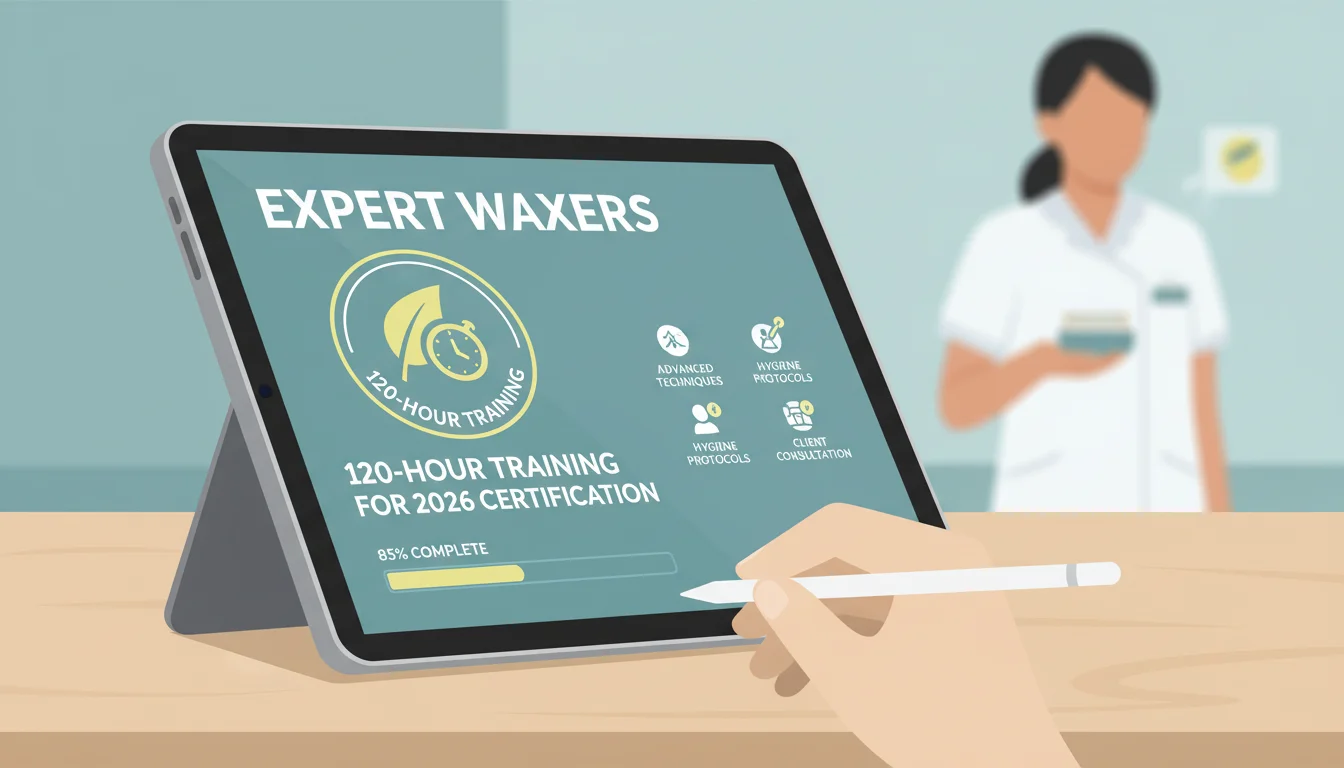
The first step is a 120-hour program, which is split between 40 hours of classroom theory and 80 hours of supervised, hands-on practice, all before a final assessment.
What kind of wax do you train with?
We focus on a proprietary hard wax formulation made to grab hair instead of skin. This makes it less painful and much safer for all skin types, especially sensitive ones.
Can your waxers handle sensitive skin or conditions like eczema?
Yes. A huge part of the training is learning to work with different skin types and conditions. Waxers learn how to do a full consultation, spot potential issues, and change their technique or products for clients with things like eczema or psoriasis to keep the service safe.
How do you make sure the service is hygienic?
We have a strict set of rules. This includes wearing personal protective equipment (PPE), a strict single-dip policy for wax applicators (no double-dipping, ever), and disinfecting every tool and surface between clients, all based on CDC guidelines.
Is there more training after someone gets certified?
Definitely. We require all certified waxers to join quarterly skill refreshers and annual advanced technique workshops. It’s the only way to keep them current with the newest products, techniques, and industry standards.


